 lltra software.

Automating Job Applications at Scale: Architecture of an AI-Powered Pipeline
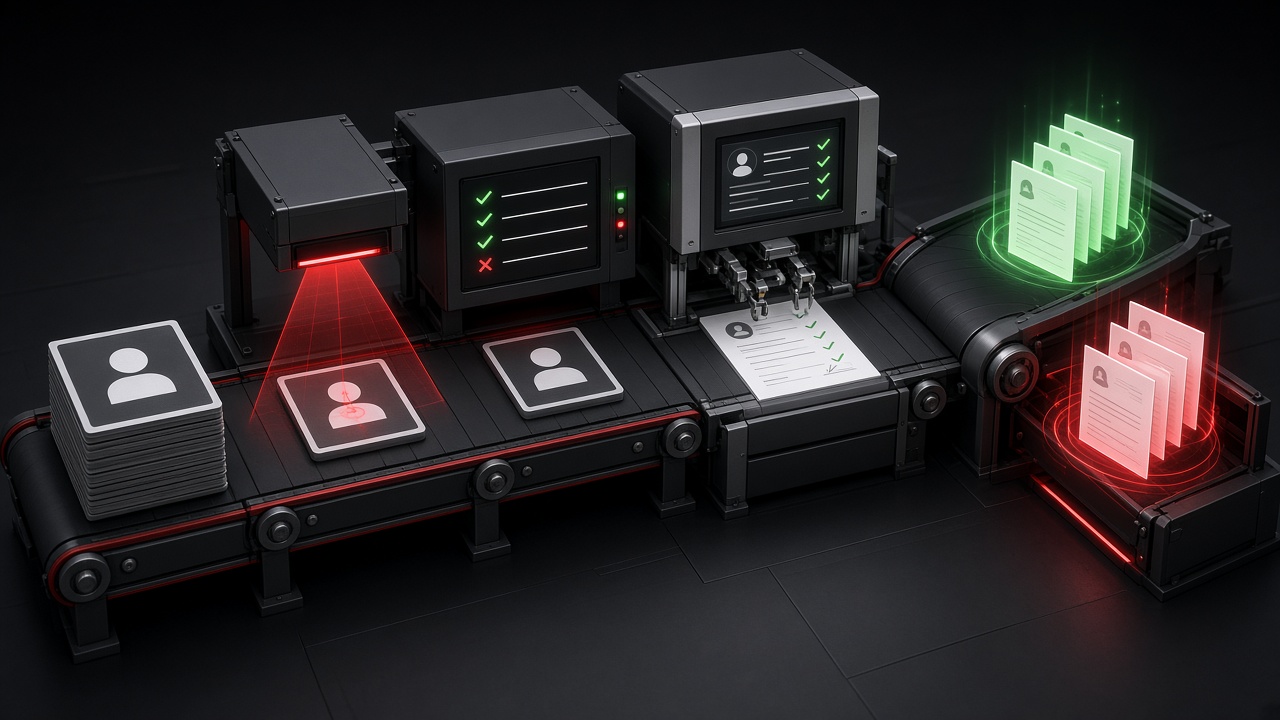
A leading US job platform approached us with an ambitious goal: help their users apply to hundreds of relevant positions automatically. Not spray and pray. Not mass blasting the same generic CV to every opening. They wanted intelligent matching, tailored applications, and full traceability. What follows is the system we designed and built, the architecture decisions behind it, and what surprised us along the way.
The core idea
Job seekers spend an enormous amount of time on repetitive tasks: searching boards, reading descriptions, deciding whether to apply, adjusting their CV, writing cover letters, filling out forms. Most of this work is mechanical. The question was whether we could automate the mechanical parts while preserving (and even improving) the quality of each application.
The answer turned out to be yes, but only if you are disciplined about where you use AI and where you keep things deterministic.
Four stages, one pipeline
We designed the system as a four stage pipeline. Each stage has a clear responsibility, a defined input and output format, and explicit rules about when LLMs are involved and when they are not.
┌─────────────┐     ┌─────────────┐     ┌─────────────┐     ┌─────────────┐
│   SCRAPE    │────▶│   SCORE     │────▶│   TAILOR    │────▶│   SUBMIT    │
│             │     │             │     │             │     │             │
│ Deterministic│    │ LLM-assisted│     │ LLM-powered │     │   Hybrid    │
│ Cron: 4 AM  │     │ Cron: 5 AM  │     │ On trigger  │     │ On trigger  │
└─────────────┘     └─────────────┘     └─────────────┘     └─────────────┘
       │                   │                   │                   │
  Job boards          Tier 1/2/3          Tailored CV         Confirmation
  Career pages        assignments         + letter             + receipt
  Aggregators                             + snapshot
Stage 1: Scrape (deterministic, no LLM)
The first stage collects job listings from multiple sources: major job boards, company career pages, and aggregators. Each source has its own scraper, and all output is normalized into a unified schema with fields like title, company, location, salary range, requirements, and posting date.
Deduplication happens at import time. So does excluded company filtering, which lets candidates blacklist specific employers they do not want to apply to (current employer, companies they have already been rejected by, and so on). This stage runs on a cron schedule, is fully deterministic, and involves zero LLM calls. There is no reason to use AI for structured data extraction when the source formats are known.
Stage 2: Score (LLM assisted)
This is where AI enters the picture. Each scraped job is scored against the candidate's profile using structured, multi dimensional criteria: skill match, location compatibility, salary range alignment, seniority fit, and culture indicators.
The output is a tiered classification. Tier 1 jobs proceed to automatic application. Tier 2 jobs are flagged for human review. Tier 3 jobs are skipped entirely.
The scoring step is where most value is created in the entire pipeline. Bad scoring means wasted applications, frustrated candidates, and degraded platform trust. We invested more time tuning scoring criteria than any other component.
A critical design decision: scoring criteria must be explicit and documented, not vibes. Each dimension has defined weights, and the platform exposes these to candidates so they can adjust priorities. "I care more about remote work than salary" is a valid preference that should change which jobs land in Tier 1.
Stage 3: Tailor (LLM powered)
For every Tier 1 job, the system generates a tailored application package. The candidate's CV is restructured to emphasize relevant experience: sections are reordered, descriptions are adjusted to mirror the job posting's language, and relevant skills are highlighted. A motivation letter is generated with job specific content that references the company and role directly.
Every application package is stored as a snapshot. This means the candidate (and the platform) can see exactly which version of the CV was sent to which company, what the motivation letter said, and when it was submitted. This audit trail turned out to be essential for debugging and for building candidate trust in the system.
Stage 4: Submit (hybrid)
Submission is the messiest stage. For known ATS platforms like Greenhouse, Lever, and Workday, the system uses deterministic form filling. These platforms have predictable structures, and their forms can be mapped reliably.
For unknown company websites with custom application flows, the system falls back to browser automation with AI guided navigation. A headless browser loads the application page, and an LLM decides which fields to fill, which buttons to click, and how to upload documents. Every submission is verified: the system checks for confirmation pages, confirmation emails, or receipt indicators before marking an application as complete.
ATS platforms are remarkably inconsistent. Even "standard" Greenhouse implementations vary significantly between companies. Custom fields, required questions, multi step flows, and file upload quirks mean that a generic ATS handler needs extensive fallback logic.
Key design decisions
Deterministic where possible, LLM only where judgment is needed. This was our guiding principle. Scraping is deterministic. Form filling on known platforms is deterministic. LLMs are reserved for tasks that genuinely require judgment: scoring relevance, tailoring language, navigating unknown UIs. This keeps costs predictable and debugging straightforward.
Scheduled execution. The pipeline runs on a fixed schedule. Scraping happens at 4 AM, scoring at 5 AM, and applications go out at 6 AM. This batch approach is simpler to operate than a real time event driven system, and for job applications, latency of a few hours is perfectly acceptable.
Full traceability. Every application is recorded with its complete context: which CV version was used, which motivation letter was generated, which channel the job was found on, and what the submission result was. This makes debugging possible and gives candidates confidence in what the system is doing on their behalf.
Candidate control. Excluded companies, scoring weight adjustments, and Tier 2 review gates ensure that candidates stay in control. The system amplifies human judgment rather than replacing it.
What surprised us
The scoring quality matters far more than application volume. In our testing, 50 well targeted, tailored applications consistently outperformed 500 generic ones in terms of response rate. This validated the entire architecture: the value is not in sending more applications, but in sending better ones.
The ATS landscape is a fragmented mess. We expected reasonable consistency across platforms and found the opposite. Even companies using the same ATS vendor configure their application flows differently. Custom questions, conditional form fields, and varied file upload mechanisms mean that the submission stage requires constant maintenance.
Tailoring quality compounds. When the system generates a genuinely relevant motivation letter that references the specific role and company, response rates climb. Recruiters notice. The difference between a generic "I am excited about this opportunity" and a letter that connects specific candidate experience to specific job requirements is dramatic.
If you are building a similar system, invest 60% of your effort in the scoring stage. Everything downstream depends on getting the right jobs into the pipeline. A perfect submission engine sending applications to the wrong jobs is worse than useless.
Results
After three months in production, the platform reported a 10x increase in application throughput per candidate and a 3x higher response rate compared to manual applications. The combination of better targeting (scoring) and better materials (tailoring) outperformed what most candidates could achieve on their own, simply because the system was more consistent and more thorough.
Building something similar?
We help companies in the HR tech and recruitment space build AI powered automation that actually works in production. If you are exploring how to bring intelligent automation to your platform, we would be glad to discuss architecture and feasibility.